Korea eSIM or SIM card: it depends on whether you need a number
There are about ten English pages competing for “best eSIM for Korea” and they all do the same thing. They rank providers by download speed and price per gigabyte. Some of them are careful and well researched.
They are also answering a question that comes second. The first one is whether you need a Korean phone number, because that decision quietly rules half the options in or out, and almost nobody leads with it.
What a Korean number actually unlocks
Korea runs a lot of ordinary life through phone-number identity verification. Not two-factor codes as a security extra. Verification as the way you prove you are a person at all, on a 010 number.
Without one, this is roughly where you land:
| Thing you want to do | Data-only eSIM |
|---|---|
| Google Maps, Naver Map, Kakao Map | Works |
| KakaoTalk, WhatsApp, Instagram | Works |
| Papago and other translation | Works |
| Tap-to-pay with a foreign card | Works |
| Call a taxi in Kakao T | Usually blocked at signup |
| Order delivery in Baemin or Coupang Eats | Blocked |
| Most Korean site registrations | Blocked |
| Receive a Korean verification SMS | No |
Foreign numbers do not reliably receive these verification texts, so keeping your home SIM in the other slot does not rescue you. The same wall turns up in places you would not expect a phone to matter at all: the national transport refund scheme verifies you by phone or Korean bank certificate before it will look at your travel at all.
Whether that matters is genuinely personal. Plenty of people spend a week here on maps and messaging alone and never miss it. But if your plan involves getting a taxi at 1am without speaking Korean to a driver, or eating in your hotel room, the number stops being optional.
The three options
| Option | Korean number | Rough cost | Suits |
|---|---|---|---|
| Data-only eSIM | No | Cheapest | Short trips, maps and messaging |
| Prepaid SIM with voice and SMS | Yes | From about 13,800 won | Anyone who wants Korean apps to work |
| Roaming from home | Keeps home number | Usually most expensive | Very short stays, or if work needs your number live |
The eSIM providers everyone compares are mostly in the first row. That is why they are cheap, and it is also why the comparison articles rarely mention what you are giving up: the products being compared all have the same limitation, so it drops out of the comparison entirely.
Some prepaid eSIM products do include voice and SMS with a Korean number. They are less common and need identity checks, usually at an airport roaming counter with your passport rather than by tapping a QR code on the plane.
Buying a prepaid SIM
You need your passport. Residents use a residence card, but as a visitor the passport is what the counter will ask for, and a copy may be taken.
Cost starts around 13,800 won, which is roughly 8,800 for the SIM plus a 5,000 won minimum top-up. Cash and cards are both fine.
They will scan your face, and have done since March
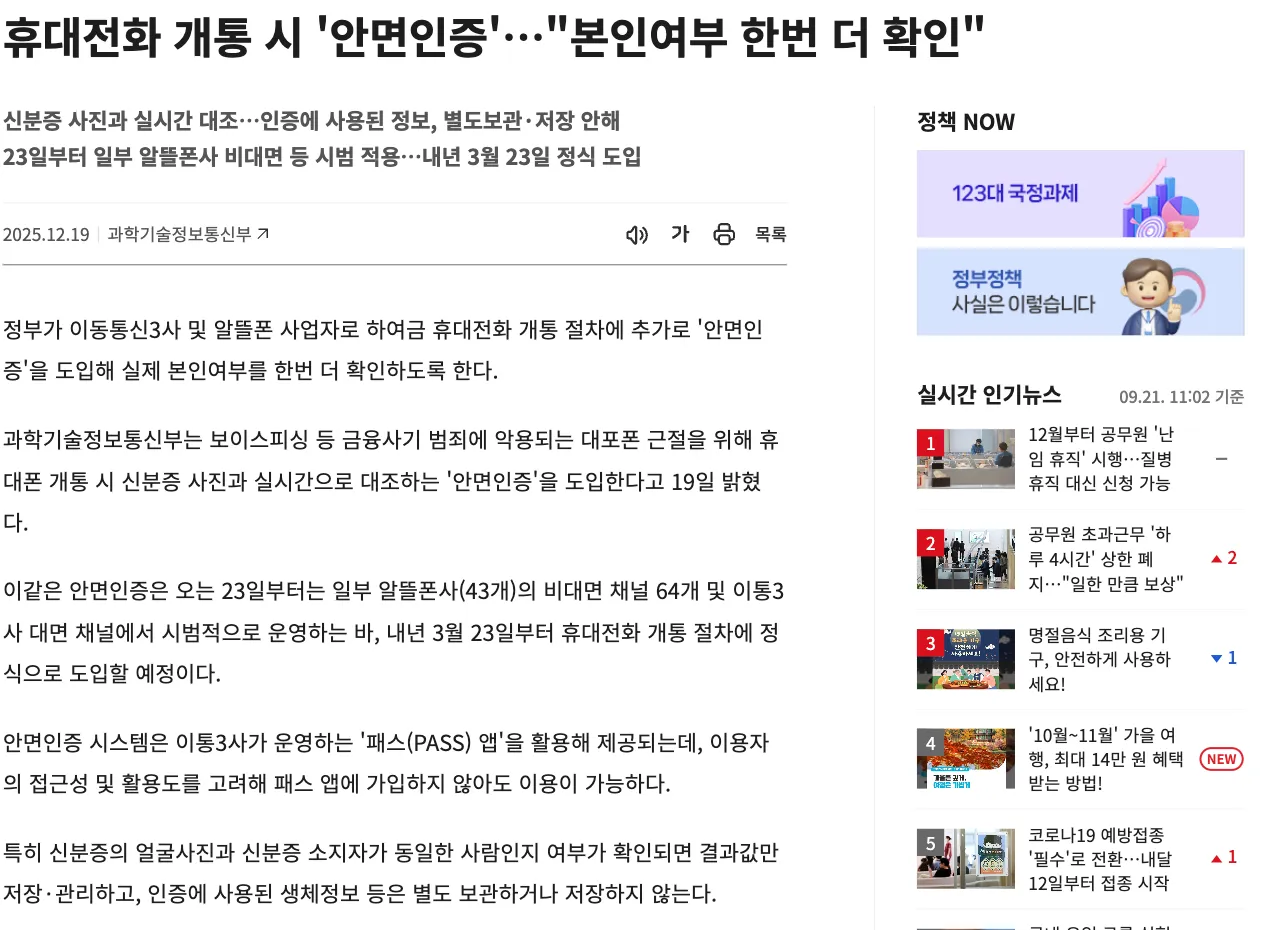
Corrected 21 September 2026. This section used to date the face scan to July 2026 and describe it as a trial still running. Both were wrong, and the briefing this page has cited all along says so. The Ministry of Science and ICT announced it on 19 December 2025: a trial from 23 December at 64 non-face-to-face channels run by 43 MVNOs and at the three big carriers’ in-person channels, then 정식 도입, formal adoption, on 23 March 2026.
So there is no grace period left to lean on. Activating a Korean mobile line includes a face verification step, and the scan is compared against the photo on your ID in real time.
It came in to stop the burner phones used in phone scams, which have been a serious problem here. The ministry ran the check through the carriers’ PASS app but built it so you do not need a PASS account to use it, and states that only the match result is kept: the biometric data used for the check is not separately retained or stored.
If you are reading an English guide that says a passport is all you need at the counter, that guide has not been updated since 2025.
The counters, and the one that never closes
Added 30 July 2026. This page used to say the airport counter hours were unchecked. They are checked now, and the answer overturns the advice everybody gives, including the advice this article gave.
The standard line is that the SIM counters shut around 22:00, so a late arrival should buy an eSIM before flying. The first half is mostly true. The second half assumes something that is not.
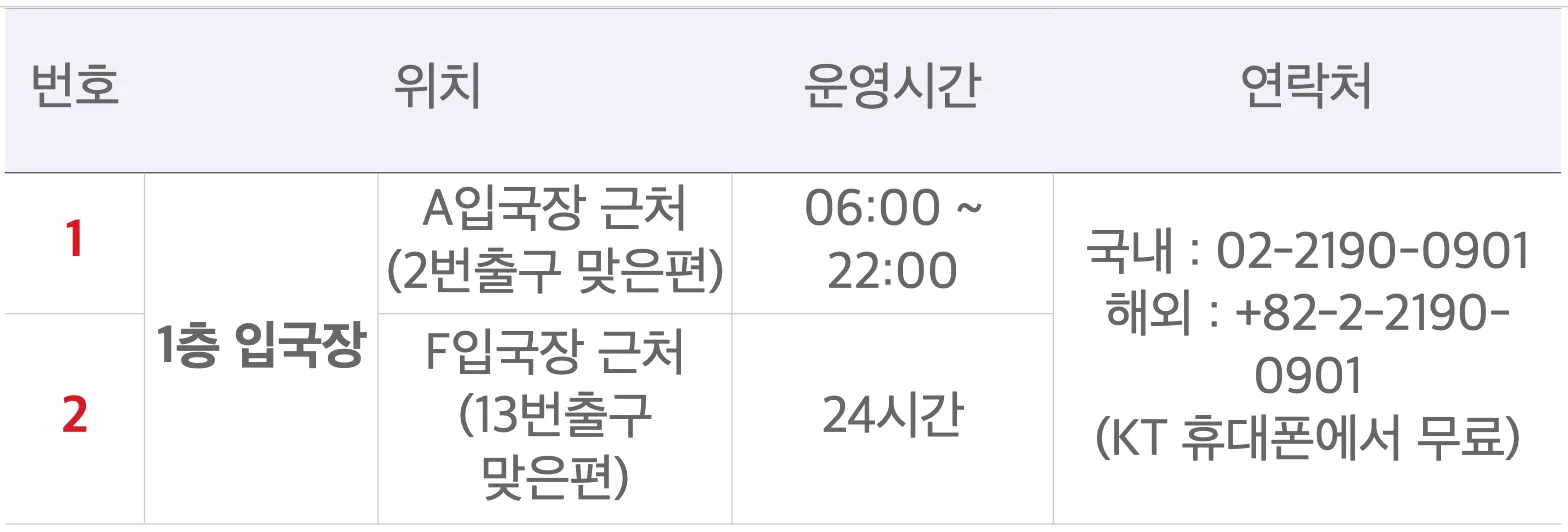
Here are KT’s own opening hours for its Incheon desks:
| Where | Hours |
|---|---|
| T1 departures, 3F, by check-in F | 06:00 to 22:00 |
| T1 departures, 3F, by check-in H | 06:00 to 14:00 |
| T1 arrivals, 1F, opposite exit 2 | 06:00 to 22:00 |
| T1 arrivals, 1F, opposite exit 13 | 24 hours |
| T2 departures, 3F, by check-in F to G | 06:00 to 22:00 |
| T2 arrivals, 1F, opposite exit 4 | 24 hours |
Read the bold rows. Each terminal has one arrivals desk that never closes, and it is on the arrivals floor, which is where you will be standing. The 22:00 cutoff people warn about applies to the departures desks and to the other arrivals desk, not to all of them.
SK Telecom runs a similar pattern in Terminal 2: the desk beside exit 3 in arrivals hall A is listed as 24 hours, and the one beside exit 4 closes at 22:00.
One caveat, and it is the reason to check a date rather than trust a page. SK Telecom’s own arrivals page still carries a notice beginning “due to COVID-19” restricting which desks are open. That notice is years old and sits directly above a table that contradicts it. Treat the table as current and the notice as something nobody deleted, and if the desk matters to your plans, phone ahead.
So the honest version: landing at 1am does not strand you. It narrows you to one desk per terminal, and you should know which one before you are standing in an empty arrivals hall at that hour looking for a lit counter.
What I would actually do
For a trip under a week where you are sightseeing, eating at places you walk into, and taking the subway: a data-only eSIM. Set it up before you fly, connect the moment the plane door opens, done. It is cheaper and there is nothing to collect.
For anything longer, or if you already know you want delivery and app taxis: get a prepaid SIM with a number at the airport. Yes it costs more and yes you have to stand at a counter. It also stops the daily papercuts where an app asks for a number you do not have.
An eSIM bought before flying still has one advantage at 1am: it works before you have found anything, including the one desk that is open. But it is no longer the only option at that hour. What has genuinely already gone by then is the last airport train, which is worth checking against your arrival time in Incheon Airport to Seoul.
What is not checked here yet
I have verified the number-verification rules, the face-scan requirement and its dates, and the airport counter hours, all against the government’s or the carrier’s own Korean pages, and re-checked the counter hours and the briefing on 21 September 2026. The T2 departures row in the table above is the one line I carried over without re-opening its tab that day.
I have not gone through current prepaid plan pricing carrier by carrier. The 13,800 won figure above is the entry price for a SIM plus its minimum top-up, not a survey of what each of the three networks charges for data. That comparison gets its own page with its own date.
If something here has moved, tell me and I will fix it.
Open this tool on its own page →
Questions people actually ask
- Do you need an eSIM for Korea, or a SIM with a Korean number?
- That is the real question, and almost every comparison answers a different one. A data-only eSIM carries maps, KakaoTalk, WhatsApp, Instagram, Papago and tap-to-pay with a foreign card, and it gives you no Korean number. Without a number you cannot get through signup for a Kakao T taxi, you are blocked on Baemin and Coupang Eats, you are blocked on most Korean site registrations, and you cannot receive a Korean verification SMS. Speed and price per gigabyte only matter after you have settled that.
- How does a Korea eSIM work, and what does it cost to issue?
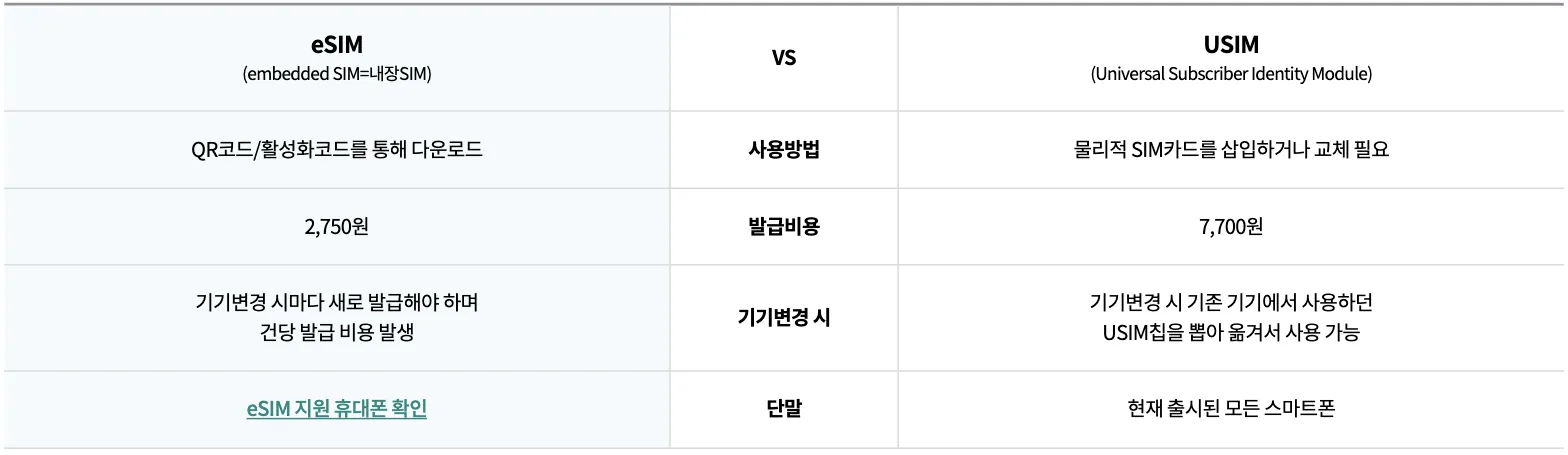
- It is a data plan downloaded onto your existing phone through a QR or activation code, with no Korean number attached. KT prices the issue itself at 2,750 won against 7,700 for a physical USIM, and publishes the catch in the next row: an eSIM has to be issued again, and paid for again, every time you change handset, where a USIM chip simply moves across. Your phone also has to be an eSIM-capable model, which every phone sold today is not.
- Kakao T and delivery apps: do you need an eSIM for Korea, or a real number?
- A real number. Korea runs ordinary life through phone-number identity verification on an 010 number, not as a security extra but as the way you prove you are a person. Kakao T taxi signup, Baemin, Coupang Eats and most Korean site registrations all stop at a Korean verification SMS that a data-only eSIM cannot receive. Opening a line now also includes a face scan checked against your ID photo, formally adopted on 23 March 2026, so bring the passport you booked with.
- Landing at 1am: do you need an eSIM for Korea to avoid a closed counter?
- No, though the advice everywhere says you do. KT publishes its Incheon hours, and each terminal keeps one arrivals desk open around the clock: Terminal 1 opposite exit 13, Terminal 2 opposite exit 4. The 22:00 cutoff people warn about is real but it belongs to the departures desks and to the other T1 arrivals desk, opposite exit 2. A late arrival narrows you to one counter per terminal rather than none, which is worth knowing before you are looking for a lit desk in an empty hall.
Where these numbers came from
Read on . 5of5are the operator's own Korean pages.
- Government policy briefing on the face-verification requirement, 19 December 2025 KO
- Ministry of Government Legislation, mobile subscription rules for foreign residents KO
- KT eSIM plans, carrier site KO
- KT roaming centre locations and opening hours at Incheon Airport KO
- SK Telecom roaming desks, Incheon Terminal 2 arrivals KO