Japan's 90 days in Korea is reciprocity, not a treaty
Ask what a Japanese passport holder needs to enter Korea and every English page gives the same answer, and the answer is right. Ninety days, no visa, no K-ETA until the end of 2026.
Then most of them add a phrase that Korea’s own foreign ministry does not use. They say the two countries have a visa waiver agreement.
The ministry publishes a column for exactly that question. Beside every nationality admitted to Korea without a visa it prints the basis, and the values are treaty, reciprocity, and unilateral exemption. Singapore is marked treaty, and so is Thailand. Japan is marked reciprocity.
What the ministry’s own table says
The table sits on the foreign ministry’s travel safety site under consular
agreements, and the page runs in two halves. I said in August that it was
marked current as of March 2025. Reopening it on 21 September 2026, the only
as-of marker on the page reads (2026.9월 기준), and it sits above the first
half, the one for Koreans going abroad. The second half, the one this article
is about, carries no date of its own. That is worth knowing before you quote
it: the table is being maintained, and the part you are reading is not the part
the date is attached to.
The first is for Koreans going abroad. The second is headed
[외국인용] 우리나라에 무사증입국이 가능한 국가/지역, which is the list of
nationalities who may enter Korea without a visa, and it is limited in its own
heading to ordinary passport holders.
Three columns: 국가명, 체류기간 and 근거, which is country, stay period
and basis. This is the Asian block a Japanese reader is in.
| Country | Stay in Korea | Basis given |
|---|---|---|
| Japan | 90 days | reciprocity |
| Taiwan | 90 days | reciprocity |
| Hong Kong | 90 days | reciprocity |
| Macao | 90 days | reciprocity |
| Singapore | 90 days | treaty |
| Thailand | 90 days | treaty |
| Malaysia | 3 months | treaty |
Same stay, different instrument. A Singaporean and a Japanese traveller walk up to the same desk with the same 90 days, and the ministry has written down that they got there by different routes.
The agreement exists. It is not about tourists
Korea and Japan did sign a visa exemption agreement, which is why the phrase in the English guides did not come from nowhere. The question is who is inside it.
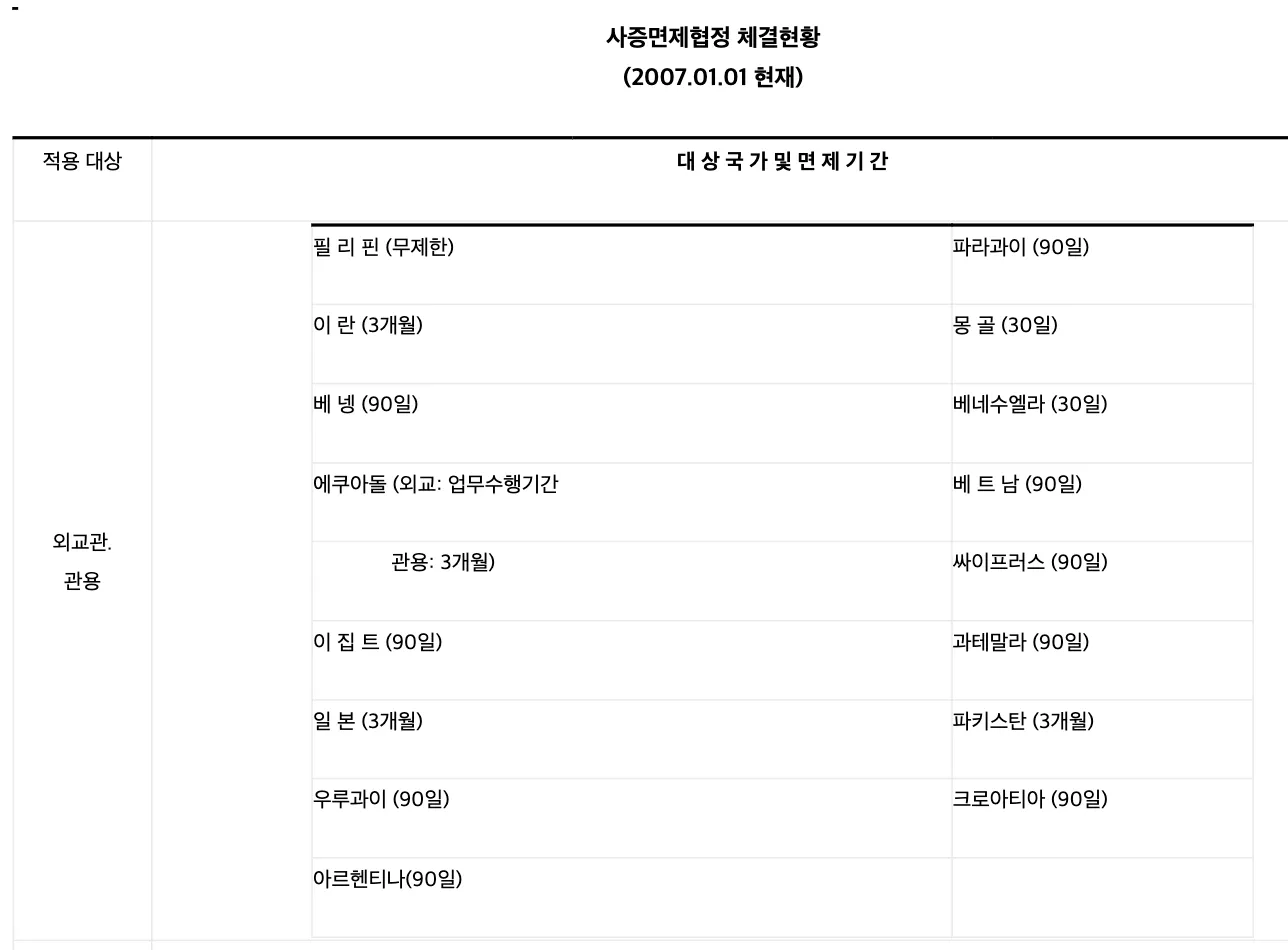
The Korean consulate in Sendai keeps a table of countries covered by visa exemption agreements, sorted by the kind of passport each agreement reaches. Japan appears once in it, at three months, in the row for diplomatic and official passports. It is not in the ordinary passport row.
Read that again. The treaty covers the people travelling on government business, and the tourist is outside it.
That is not a loophole and nobody is being short-changed. A great many exemption agreements are written that way, starting with diplomats and never extended downward, because the practical arrangement got there first and the paperwork never needed to catch up. But it does mean the sentence “Japan and Korea have a visa waiver agreement” describes a document that a holidaymaker is not named in.
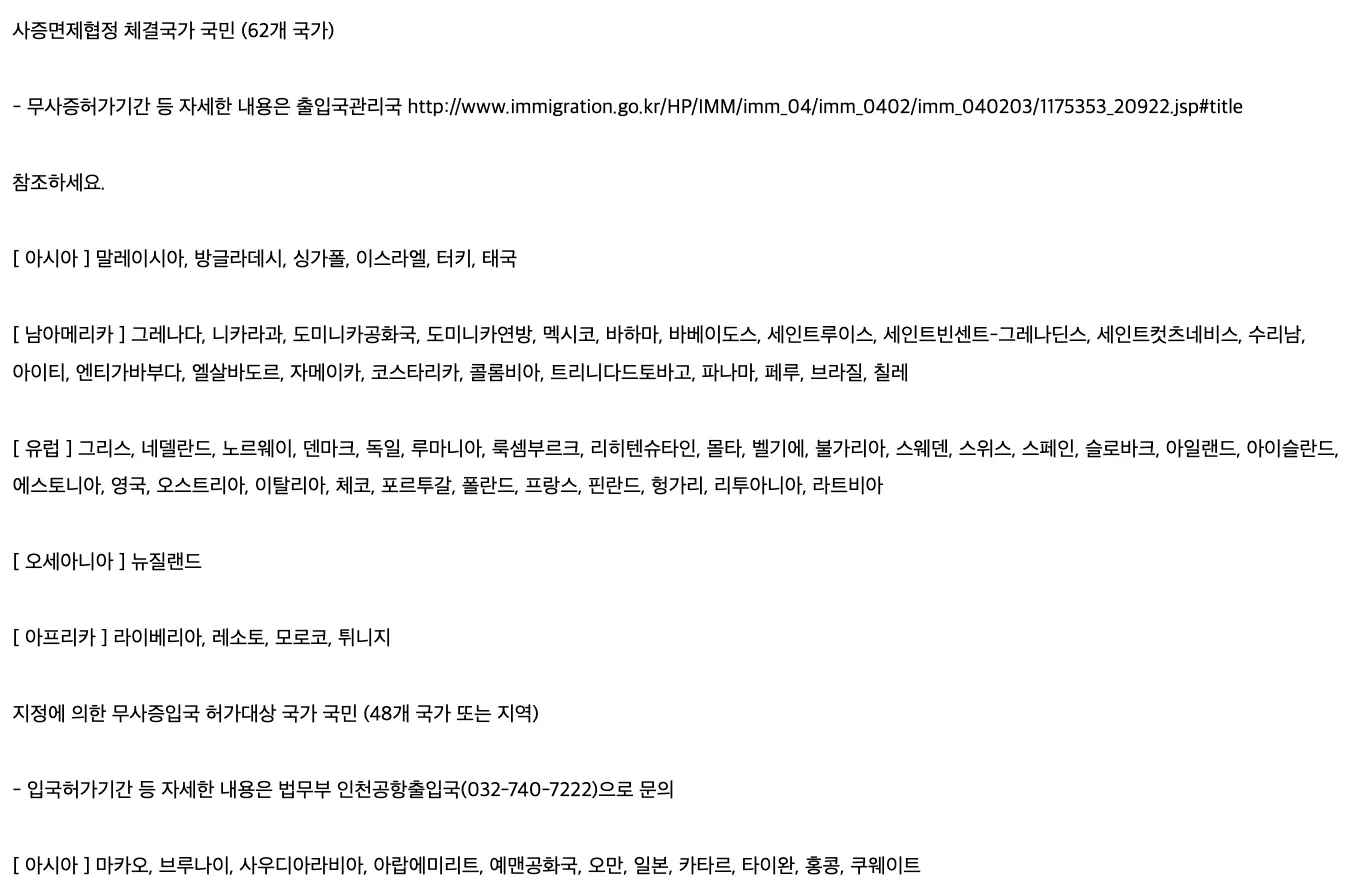
The same Sendai page also splits its subject into two populations, and the split is the whole argument in the ministry’s own filing. It counts 62 countries whose nationals travel on a concluded visa exemption agreement, and then separately counts 48 countries and regions whose nationals are admitted by designation. Those are two different mechanisms with two different headcounts, printed on one page, and an ordinary Japanese passport is not in the first group.
The consulate in Chicago publishes its own version of the same list, last edited on 18 September 2019, and its Japan row carries the same word: reciprocity. Two consulates on two continents, eleven years apart, filing Japan in the same place.
What reciprocity changes, and what it does not
Nothing about your next trip. If you are flying to Seoul this weekend the answer is 90 days and no visa, and this section will not alter a thing you pack.
What it changes is how the rule can move. The ministry’s own definition of the
system says visa exemption comes about 국가간 협정이나 일방 혹은 상호 조치에 의해, by agreement between states or by unilateral or reciprocal measure. It
sets an agreement and a measure beside each other as different things. A measure
is something a government adopts, and a treaty is something two governments have
to reopen.
This site watched that distinction do real work earlier this year. Korea’s group visa-free arrangement for Chinese tourists was extended by a decision announced at a prime ministerial meeting, and the written implementation plan still carried the old expiry date weeks afterwards. That is the shape of a measure. It moves when a government decides it moves, and the documents follow later or not at all. The full account is in why Korea’s China visa-free rule is not what the documents say.
So the honest reading for a Japanese traveller is not that the 90 days is fragile. Nothing in these pages suggests either government is reconsidering it, and none of them records how long the arrangement has stood, so treat its age as unknown rather than as proof that it is settled by long habit. What the filing tells you is that the 90 days sits in the same category as the arrangements that did move this year, and that if it ever changes it will change the way those changed, which is by announcement rather than by amendment.
The second measure, and this one has a date printed on it
The K-ETA waiver is the other half of a Japanese traveller’s entry, and it is much more clearly temporary, because it says so.
Japan is one of the 22 countries and regions inside the temporary K-ETA exemption, and it is listed first among the Asian entries on the notice the Korean Embassy in Japan publishes. The current extension runs to 31 December 2026, which the embassy in Australia states in its own headline. The full list and the traps in it are in who actually needs a K-ETA, by nationality.
The Japan-facing notice is worth a warning of its own. Its body still reads
2023.4.1.부터 2024.12.31.까지, the window that closed at the end of 2024, and
the live dates sit in the attachments and on other missions’ pages. The page was
edited on 10 June 2026, so it is being maintained, and the sentence a reader
lands on was not the part that got maintained. If you check your own eligibility
against that notice, open the attachment rather than trusting the paragraph.
Two measures, then, stacked. The 90 days with no end date attached, and the K-ETA waiver with 31 December 2026 attached. Neither is a treaty. One of them tells you when it stops.
The form you file instead, and why it is two forms for a weekend
Here is where the exemption costs a Japanese traveller something, and it is the part the good news buries.
The Ministry of Justice publishes two lists on the arrival card site, one above
the other. The people who must file are headed by visa holders and
K-ETA 면제자, people exempt from K-ETA. The people excused from filing include
K-ETA 소지자, people who hold one.
Exempt is on the list that files. Holder is on the list that does not. A Japanese traveller inside the waiver is the first of those and not the second, so the card is theirs.
The way out is to buy the thing you were told you did not need. The full working of that, including the fee and who else lands in the same position, is in the e-Arrival card and the K-ETA that cancels it.
For a Tokyo to Seoul weekend this is the whole practical difference. Two filings, one on the way out and one on the way back, each with its own window to land in.
The lane Korea built for Japanese arrivals, and where it went
In 2025, for the sixtieth anniversary of normalised relations, the two governments opened immigration lanes reserved for each other’s nationals. I know of no second country Korea has done this for, and none of these three notices claims it is unique, so treat that as my reading of a gap rather than as something the ministry has stated.
The conditions were narrow, and the policy briefing sets them out. The dates are from the embassy notice, which is the only one of the three to print them.
| Condition | What it required |
|---|---|
| When | 1 to 30 June 2025, one month |
| Korean airports | Gimpo, on Korean Air, Asiana, JAL and ANA only. Gimhae, any airline |
| Japanese airports | Haneda Terminal 3, the same four airlines. Fukuoka, any airline |
| The flight | Departing your own country, landing between 09:00 and 16:00 |
| Who | Short-stay visitors who had been to the other country at least once in the year before arrival |
| Ticket to the lane | For Japanese arrivals, a completed e-Arrival card, shown at the door |
That last row is the one worth keeping. The embassy notice says a Japanese traveller wanting the lane had to finish the arrival card before flying, and then show the confirmation screen, which displayed whether the lane was open to them, to the guide at the entrance.
So the fast lane’s entry ticket was the form. A traveller who had bought a K-ETA to avoid filing arrival cards would have arrived at a Japan-only lane without the document that opened it.
The trial ran its month and stopped. The foreign ministry release calls it part of the anniversary programme and closes by saying the two governments will keep talking about ways to make travel easier, which is not a commitment to run it again. I have found no notice announcing a second run, and an absence of notices is weaker evidence than a notice would be, so do not read this as the lane having been formally closed. Treat it as a trial whose stated month has passed, plan your arrival without it, and watch for a fresh notice.
One detail about the sources is worth recording. The embassy notice keeps the flight list and the usage instructions in attached PDF files rather than on the page, so a reader who opens the notice and stops there gets the conditions without the airports and airlines they apply to. The airport list above is from the government policy briefing, which publishes it as text.
What Japanese travellers got in December, and where it does not reach
Something else opened later that year, and it is narrower than the headlines about it.
From 1 December 2025 the Ministry of Justice opened Korea’s automated immigration gates to holders of 18 passports, up from 4. The four were Germany, Taiwan, Hong Kong and Macao. The fourteen added were the United Kingdom, France, Italy, Finland, Portugal, Czechia, the Netherlands, Hungary, Australia, New Zealand, Mexico, Japan, Singapore and the United Arab Emirates. The ministry expected the change to reach about 40% of all foreign arrivals.
The airport matters more than the country list here. This is a trial at Incheon, and the policy briefing says so in its own headline. Pre-registration went from one desk to four, and all four of them are in Incheon’s arrival halls, at the east and west sides of both terminals. The briefing closes by saying the ministry would use the Incheon results to decide, in January 2026, whether to extend the gates to airports nationwide.
So the December opening does not land where the June lane did. Gimpo and Gimhae are the two Korean airports the Japanese lane used, and they are the airports a Tokyo or Fukuoka weekend actually arrives at. Neither is Incheon.
Whether that January review happened, and what it decided, is not something I have checked, and the briefing that promised it is more than half a year old now. So if you land at Incheon, register at one of the four desks and use the gate. If you land at Gimpo or Gimhae, plan for the ordinary queue and treat anything faster as a surprise.
What I have not confirmed
- Whether the dedicated lane has a second run scheduled. I found no notice announcing one, and the absence of a notice is weaker evidence than a notice would be. If it returns, the arrival card requirement is the thing to re-read.
- What Korea’s foreign ministry means by reciprocity in the legal sense. The page names the category and gives no definition, so what I have written above is drawn from the ministry setting agreements and measures side by side in its own definition of the system, not from a statement of legal effect.
- Whether the Sendai consulate’s table still describes the current agreement. It was written on 23 January 2008 and states its own figures as of 1 January 2007, so treat it as a 2007 reading of which passports the treaty reaches. The Chicago page from 2019 and the March 2025 table agree with it on Japan’s basis, which is the reason I have used it.
- What the January 2026 review of the automated gates decided. The December briefing is explicit that the gates were an Incheon trial and that a decision on extending them to airports nationwide was due in January 2026. I have not found the notice that would say what was decided, so treat the gates as Incheon-only until one turns up.
- Anything about entering Korea by ferry. The routes exist and none of my sources here describe how the paperwork works at a sea border.
If you have stood in one of these lines recently and it did not work the way this page says, tell me and I will re-read the source and date the correction.
![The Asia and Pacific panel of the foreign ministry's table headed [외국인용] 우리나라에 무사증입국이 가능한 국가/지역, countries and regions whose nationals may enter Korea without a visa. Three columns of country, stay period and basis. 일본 reads 90일 and 상호주의, 대만 reads 90일 and 상호주의, 마카오 and 홍콩 the same. 싱가포르 reads 90일 and 협정, 태국 reads 90일 and 협정, 말레이시아 reads 3개월 and 협정. 호주 and 나우루 read 일방적 면제](/_astro/visa-free-basis-asia-pacific.BvH7_aXo_D0i9t.webp)
Questions people actually ask
- Do Japanese need visa for Korea, or is the 90 days automatic?
- Not for a short visit on an ordinary Japanese passport, and the 90 days is granted at the desk rather than applied for. The foreign ministry lists that stay period in its table of nationalities who may enter Korea visa-free. The table also gives the basis for each one, and the value beside Japan is reciprocity rather than treaty.
- Is Korea visa free for Japanese because the two countries signed something?
- The two countries did sign a visa exemption agreement, but the consulate table that lists it puts Japan under 외교관.관용, diplomatic and official passports, at three months. An ordinary passport is outside that document. The ministry marks Japan 상호주의, reciprocity, on the table that covers ordinary travellers, alongside Taiwan, Hong Kong and Macao. Singapore and Thailand are the ones marked 협정, treaty, at the same 90 days.
- Japan to Korea visa requirements: what do I file instead of a visa?
- The e-Arrival card, once per entry. Japan is inside the temporary K-ETA waiver that runs to 31 December 2026, so there is no K-ETA to apply for. The exemption from the arrival card is written for people who hold a valid K-ETA, and a Japanese traveller inside the waiver holds none, so the card falls to them instead.
- Do Japanese need a visa to visit Korea twice in the same week?
- No, and the 90 days is not consumed in a way that blocks a second trip. What repeats is the paperwork. Because the arrival card waiver attaches to holding a K-ETA and a Japanese traveller holds none, the e-Arrival card is filed for each entry. A Friday out and a Sunday back is two filings, not one.
- Do Japanese citizens need visa for Korea once the K-ETA waiver ends?
- Still no visa. The waiver that runs to 31 December 2026 suspends K-ETA, not visa-free entry, and the two sit on different footings. If it lapses rather than being extended again, a Japanese traveller would be applying for K-ETA before departure and would then fall inside the arrival card exemption instead of outside it. The waiver has already been extended more than once, so the date is the thing to re-check, not the rule.
Where these numbers came from
Read on . 11of11are the operator's own Korean pages.
- 외교부 해외안전여행, 영사협정-사증면제, [외국인용] 무사증입국 표의 국가명·체류기간·근거 열 (2026-09-21 확인, 이 표에는 기준일 표기가 없다) KO
- 주시카고 대한민국 총영사관, 비자면제협정국가, 일본 행의 근거를 상호주의로 적은 판 (2019-09-18) KO
- 주센다이 대한민국 총영사관, 비자면제 협정국가, 일본을 외교관·관용 칸에 넣은 표 (2008-01-23 작성, 2007-01-01 기준) KO
- 외교부 보도자료, 한일 양국 전용 입국심사대 운영 (2025-05-21) KO
- 대한민국 정책브리핑, 한·일 전용 입국심사대 6월 한 달 운영, 공항·항공사·시간대 조건 (2025-05-22) KO
- 주일본 대한민국 대사관, 한일 전용 입국심사대 운영 공지, 전자입국신고 요건 (2025-05-21 작성, 05-23 수정) KO
- 법무부 보도자료, 자동출입국심사 이용 국가 18개국으로 확대 (2025-12-01) KO
- 대한민국 정책브리핑, 인천공항 자동출입국심사 18개국으로 확대, 추가 14개국 명단과 사전등록 장소 (2025-12-01) KO
- 주일본 대한민국 대사관, K-ETA 한시 면제 22개 국가·지역 명단. 본문 기간은 아직 2024.12.31 (2026-06-10 수정) KO
- 주호주 대한민국 대사관, K-ETA 한시 면제 시행 연장 안내 (2026년 12월 31일까지) KO
- 법무부 전자입국신고, 신고 대상자와 신고 제외 대상자 목록 (K-ETA 면제자는 대상, K-ETA 소지자는 제외) KO