Foreign cards buy a Seoul subway ticket, not a T-money top-up
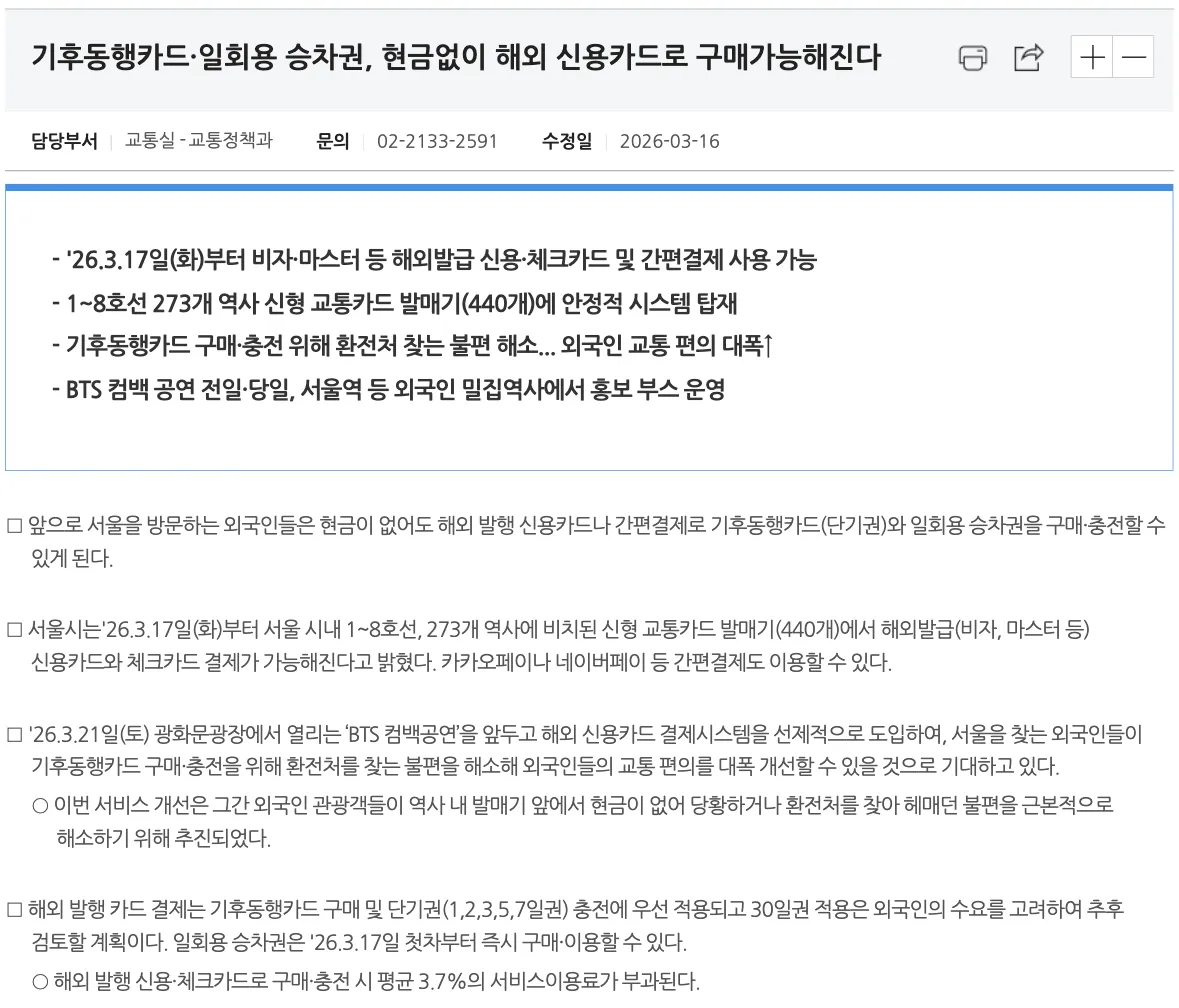
Since 17 March 2026 the newer ticket machines in Seoul subway stations take a foreign Visa or Mastercard. They will sell you a single-journey ticket and a Climate Card pass, and they will not put a single won on a plastic T-money card.
The interesting part is the reason, because it is not that your card is foreign. On the page where T-money sets out how the plastic card gets topped up, there is one card route in the whole country and it belongs to a single bank. A Shinhan card issued in Seoul to a Korean citizen has no more of a top-up route there than yours does.
What actually changed on 17 March 2026
Seoul put overseas card acceptance onto 440 new ticket machines across 273 stations on subway lines 1 to 8. Single-journey tickets were live from the first train that morning.
Read the notice’s two lists carefully, because they behave differently. The card brands and the easy-pay methods are given as examples, in the Korean form that means “Visa, Mastercard and the like” and “Kakao Pay, Naver Pay and the like”. The products are not examples. Reporting of the launch puts it as overseas cards being usable only for the items below:
| What the machine sells to a foreign card | Included |
|---|---|
| Single-journey ticket | Yes |
| Climate Card, purchase of the card itself | Yes |
| Climate Card 1, 2, 3, 5 and 7-day short passes, top-up | Yes |
| Climate Card 30-day pass | To be reviewed |
| Plastic T-money balance | No |
So if you hold an Amex, a UnionPay card or WeChat Pay, the open list is the one that matters and you are probably fine. If you want a T-money balance, the closed list is the one that matters and you are not.
On the 30-day row Seoul says it will review adding the monthly pass in the light of demand from foreign visitors. That is a decision deferred rather than a decision made, and it is worth resisting the temptation to read a verdict into it.
Two scope limits before you plan around this. The notice covers Seoul subway lines 1 to 8 and names no others, which leaves out the airport railroad, line 9 and the Ui-Sinseol line. And this is Seoul. Busan, Daegu and the rest run their own machines and were not part of it.
Why the timing was March
Seoul says it brought the payment system in ahead of schedule for the BTS comeback concert at Gwanghwamun Square on 21 March 2026, and ran promotion booths at Seoul, Hongik University and Myeongdong stations over that weekend. The benefit the notice describes is the ordinary one, which is visitors no longer stranded at a machine with no cash and hunting for somewhere to change money.
That is worth knowing because the same programme had already promised this. An October 2025 notice said foreign card top-up at the kiosks would arrive by the end of that year, and it arrived in March. A concert moved it, which tells you more about how these dates hold than any of the roadmap years further down this page.
The top-up rule that catches Korean cards too
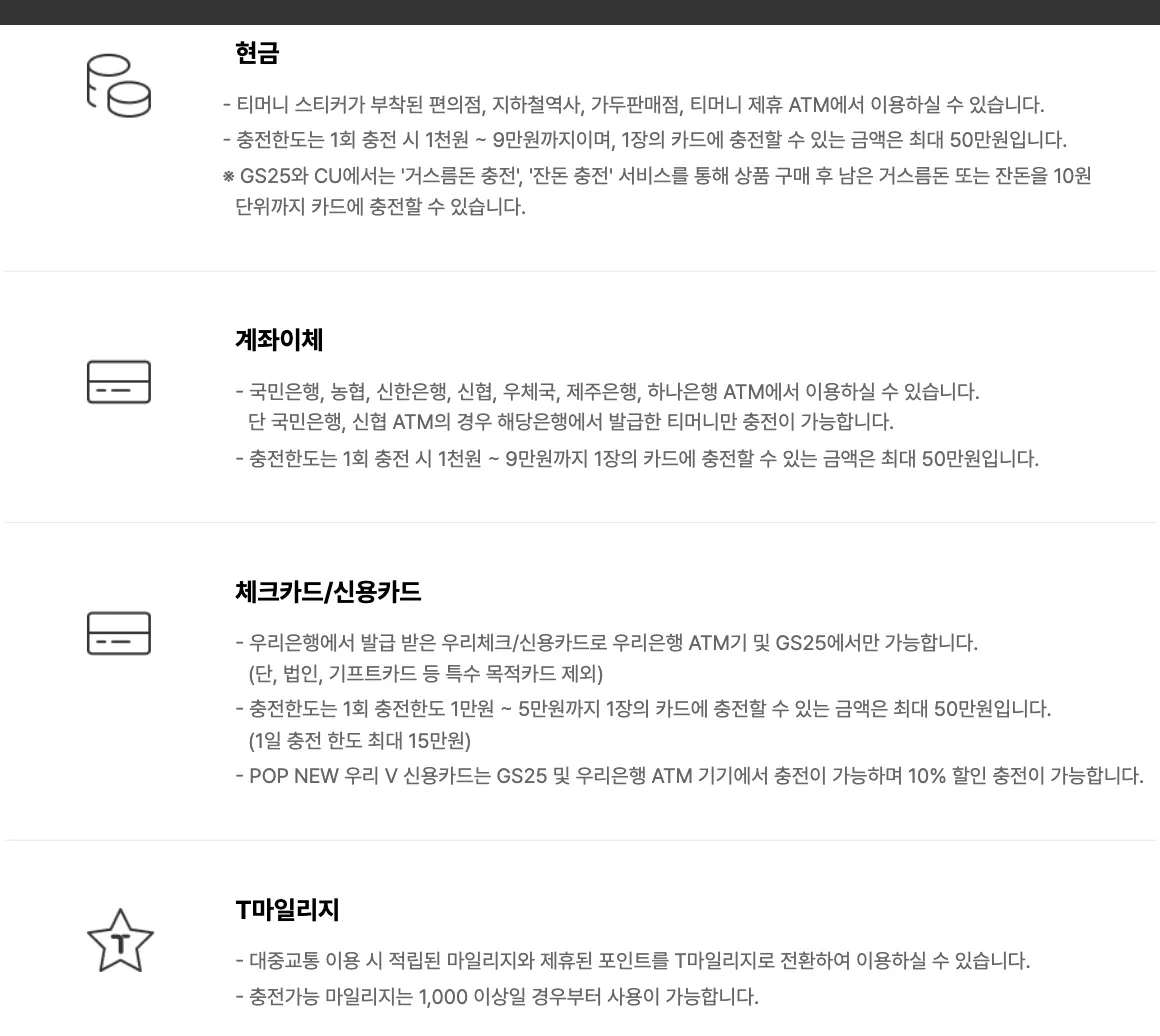
T-money publishes the means it accepts for the plastic prepaid card. There are four, and the third is the one worth stopping on:
| Means | Where it works |
|---|---|
| Cash | Convenience stores, stations, street stalls and partner ATMs carrying the T-money sticker |
| Bank transfer | ATMs of seven named Korean banks |
| Cheque or credit card | Woori Bank cards only, at Woori Bank ATMs and GS25 |
| T-mileage | Converted from accumulated points |
The card channel is not a card channel in any general sense. It is one issuer’s cards, at that issuer’s ATMs and one convenience store chain, capped lower per top-up than cash and capped again per day. A Hana card fails there. A KB card fails there. There is no foreign card route on that page because there is barely a card route at all.
What that page does not do is explain Seoul’s kiosk. The two documents are unrelated, and the notice makes clear that the transport operator was on the build rather than sitting outside it: Seoul lists T-money alongside Hana Card, Nice Information and Communication and Seoul Metro as the partners it worked with on the payment and settlement systems. So the exclusion of a T-money balance is a scope decision somebody made, and neither document says why.
The other T-money, which plays by different rules
Here is where the site’s own first draft of this page went wrong, and it is worth saying rather than quietly fixing. There is not one T-money product. The Woori-only rule above governs the plastic card. T-money’s list of top-up places also carries a mobile card, and that entry reads simply that it can be charged by account, by cheque or credit card, or by phone, with no bank named anywhere in it.
Seoul’s October 2025 notice goes further. On Galaxy and other Android handsets, it says, T-money’s Korea Tour Card app already accepts an overseas card, written in the present tense as a thing that works. The same notice puts the iPhone equivalent in the future tense, saying a foreign card top-up inside T-money on Apple Pay was being pushed for within that year. That year has ended and I found no later notice confirming it, so treat the Apple route as announced rather than running.
| Route | Overseas card |
|---|---|
| Plastic T-money card, at a counter or a machine | Woori Bank cards only, so no |
| T-money mobile card | Cheque or credit card, no issuer named |
| Korea Tour Card app, Android | Stated as working, October 2025 |
| T-money on Apple Pay | Stated as intended by end of 2025, unconfirmed since |
| Subway kiosk, tickets and Climate Card passes | Yes, from 17 March 2026 |
The division is between the plastic and the phone rather than between Korean cards and foreign ones. The card in your pocket is the only row with nothing to feed it but cash.
So where does the cash come from
T-money attaches a condition to cash that most guides drop: the shop, station, stall or ATM has to be one that carries its sticker or is a partner. In practice that is most of them. It names GS25, CU, 7-Eleven, Ministop, Storyway and emart24 among the chains, staffed and unstaffed chargers inside metropolitan subway lines 1 to 4, and stalls and independent shops reaching across metropolitan lines 1 to 9 and Incheon lines 1 and 2. Its street-stall coverage is published as a regional list rather than as blanket national coverage.
If you would rather not carry notes, the account transfer route works at the ATMs of the seven banks T-money names, which include KB, NH, Shinhan, Hana and the post office. It needs a Korean account, which for most visitors puts it back out of reach and lands you at the same answer.
The honest summary for a short trip: change or withdraw enough won for the transport card on the first day, then use the foreign card for everything else. The card itself is cheap and earns its keep on transfers rather than on fares, so the sum you need is smaller than most itinerary pages suggest.
The fee, which is in the notice and almost nowhere else
Paying with an overseas-issued credit or debit card at these machines carries an average service fee of 3.7%. Seoul states it plainly, in the same notice that describes the change as sparing visitors the search for somewhere to change money.
The comparison a reader actually needs is against your own bank’s foreign transaction charge, which the city has no way of knowing. Treat 3.7% as a figure to budget against rather than one you can predict to the won, because Seoul publishes it as an average and not as a rate.
Who is actually using it, and it is not only tourists
Seoul’s early figures were reported in the press. Between 17 March and 17 April 2026 the machines took a daily average of 9,158 users paying about 70 million won a day by overseas card and easy-pay.
That is roughly 7,600 won a head, which is about the size of a single-journey ticket and a spare, or a first charge on a short pass. Small purchases at a machine on the way in, which is the errand the change was aimed at.
The breakdown is the part worth having, and it is published in transactions rather than people. Visa led the cards at 3,788 a day. Among easy-pay methods WeChat Pay was the largest at 2,069 a day, well ahead of domestic easy-pay methods at 628. Two things follow. Chinese visitors are the heaviest users of a service the English coverage frames around Visa and Mastercard, and the count includes Korean residents, so this is not a pure measure of foreign demand.
Tapping your own card at the gate is further off than the fee change suggests
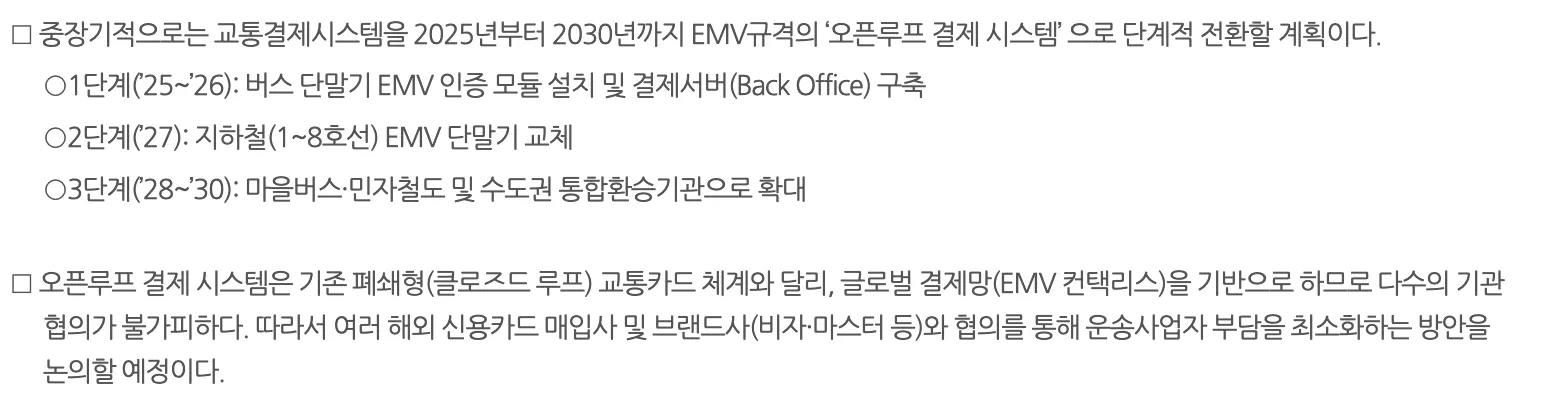
The change above is about buying a Korean transport product with a foreign card. Using your own contactless card as the transport product, the way London and Sydney work, is a separate programme, and Seoul has published stages for it:
| Stage | Years | What is being built |
|---|---|---|
| 1 | 2025 to 2026 | EMV modules on bus readers, and the payment back office |
| 2 | 2027 | Replacing the reader hardware on subway lines 1 to 8 |
| 3 | 2028 to 2030 | Village buses, private railways, and the metropolitan transfer network |
Note what those years describe. They are build stages, and the notice attaches no date on which a passenger can first tap a card at a gate. My own reading is that a stage finishing in 2026 is a bus network that becomes useful to you some time after that rather than during it, but the city has not said so, and any page telling you open-loop payment starts in 2025 is reading the first column as a launch date.
The pass the machine now sells is being switched off
There is a wrinkle the English pages covering the March change have not caught up with. The Climate Card the kiosk will now sell to your foreign card is a product Seoul is retiring, on a schedule this site has been tracking since July: the 30-day version stops taking charges at the end of August and the scheme closes in the autumn, with the dates and the replacement set out in full on its own page.
The short passes survive that, which is why they are still worth buying. If you are visiting for under a week, none of it reaches you and the kiosk is simply a more convenient way to buy what you were going to buy anyway.
What is not confirmed here
The March change, the products, the 3.7% fee, the station and machine counts, the BTS timing, and the top-up means and places all come from Seoul’s and T-money’s own Korean pages. I opened all three again on 21 September 2026 to take the pictures on this page, and every figure above still reads the same on them. The usage figures come from a newspaper report of the city’s numbers rather than from a city page, so they carry one more link in the chain than everything else here, and that report I have not re-opened since August.
The staged rollout years and the Android app route come from a Seoul notice last revised on 16 October 2025, which has not been touched since. One promise in that same paragraph, the Apple Pay route by the end of 2025, has quietly passed its date with no follow-up notice, so treat the rest of that page as a plan of that date rather than as a report of today.
Nobody states which card brands the Android app takes. Seoul says the route exists and stops there; T-money’s own pages say the mobile card accepts an account, a cheque or credit card, or a phone bill, and name no brands either. Two English guides fill that silence in opposite directions, one saying an overseas Visa is excluded while Mastercard, Amex and UnionPay work, the other listing Visa among the brands it accepts. So do not build an arrival day around loading the app at the airport. Get cash for the first top-up and test the app afterwards, when being wrong costs you an evening rather than a journey.
I have not verified whether the app route needs a Korean phone number to complete sign-up. It would be consistent with the verification wall that a data-only eSIM runs into, but consistency is not a source, and nothing I read today states it.
I have also not checked the restaurant ordering kiosks and older taxis that turn up in traveller accounts of foreign cards being refused. Those are individual merchants and payment terminals rather than one operator with a published rule, so they need their own page and their own evidence, and I would rather leave the gap named than fill it from anecdote.
If a machine has taken or refused your card recently, and you can say which station and which card, tell me. That is the kind of report that closes a gap like the one above.
Questions people actually ask
- What does the Seoul subway foreign credit card change actually cover?
- From 17 March 2026, 440 new ticket machines across 273 stations on lines 1 to 8. Seoul names Visa and Mastercard among overseas brands and Kakao Pay and Naver Pay among easy-pay methods, and writes both lists as examples rather than as the complete set. What is genuinely closed is the product list: single-journey tickets, buying a Climate Card, and charging its 1, 2, 3, 5 and 7-day short passes. A balance on the plastic T-money card is not on it.
- Can I top up a plastic T-money card with a foreign credit card?
- No, and the reason is not that your card is foreign. On the page where T-money sets out how the plastic card is filled, the whole card route is a Woori cheque or credit card issued by Woori Bank, used at a Woori Bank ATM or a GS25. A Shinhan card issued in Seoul to a Korean citizen is refused there too. Every other means it lists for that card is cash, a transfer from a Korean bank account, or accumulated mileage.
- Which Korea transport card for foreigners can be topped up without cash?
- The one on your phone rather than the one in your pocket. T-money lists its mobile card as chargeable by account, by cheque or credit card, or by phone bill, naming no issuer, and Seoul says the Korea Tour Card app on Android already takes an overseas card. The plastic card has no route that is open to you. For a short trip the honest plan is cash for the card and the foreign card for everything else.
- Climate Card Seoul for foreigners: can I buy one with an overseas card?
- Yes, at the new machines, and this is the part worth knowing. Seoul lists buying the Climate Card itself and charging its 1, 2, 3, 5 and 7-day short passes among the products an overseas card can pay for. The 30-day pass is marked as a decision deferred rather than made. Seoul is also retiring the Climate Card on a published schedule, so check the dates before you buy a pass that outlasts the scheme.
- Can you tap credit card on Seoul subway gates yet?
- Not yet, and Seoul has published construction stages rather than a launch date. Its plan puts EMV modules and the payment server on bus readers across 2025 and 2026, replaces the reader hardware on subway lines 1 to 8 in 2027, and extends to village buses, private railways and the wider metropolitan transfer network between 2028 and 2030. The notice does not say when passengers can first tap, so read those years as build dates.
- Is there a fee for paying with a foreign card at a Seoul subway machine?
- Yes. Seoul states an average service fee of 3.7% on purchases and top-ups made with an overseas-issued credit or debit card at these machines. That is charged on top of whatever your own bank adds for a foreign transaction, and the city publishes it as an average rather than a fixed rate, so treat 3.7% as the figure to budget against rather than the exact number you will see.
Where these numbers came from
Read on . 5of6are the operator's own Korean pages.
- Seoul Metropolitan Government, foreign card payment at subway ticket machines from 17 March 2026 KO
- Seoul Metropolitan Government, staged rollout of EMV open-loop transport payment KO
- T-money, the means accepted for topping up a card KO
- T-money, where a card can be topped up KO
- Kyunghyang Shinmun, usage in the first month of foreign card payment on the Seoul subway KO
- Seoul Metropolitan Government, English version of the 17 March notice