T-money card in Seoul: what it costs, and the pass ending 1 October
Get a T-money card. Every guide says it, and every guide is right. It is sold in any convenience store, it works on buses, subways, taxis and in the shops, and you are going to want one.
What almost none of them tell you is where the money actually comes from, and it is not where you would guess. The card is barely cheaper than paying per ride. The saving is in the transfer rules, and those rules have conditions that are easy to break without noticing.
What the card saves, precisely
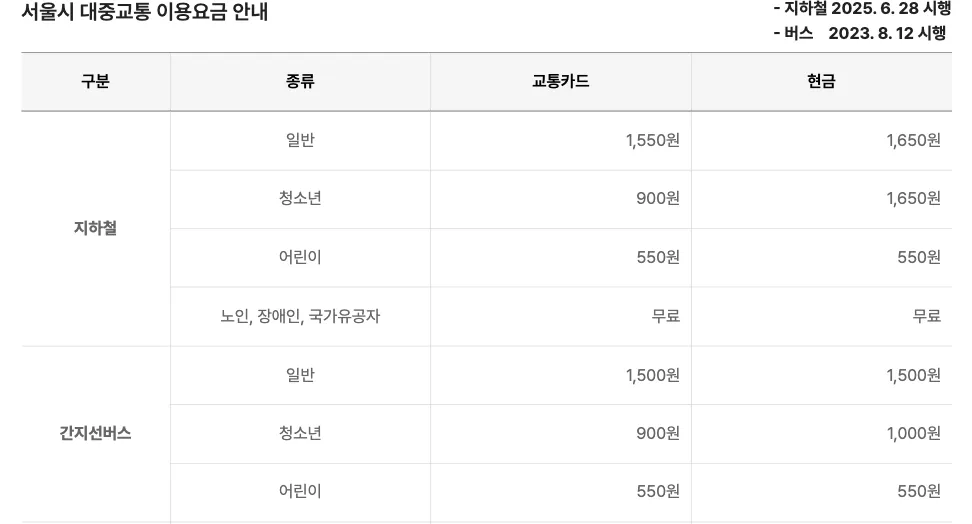
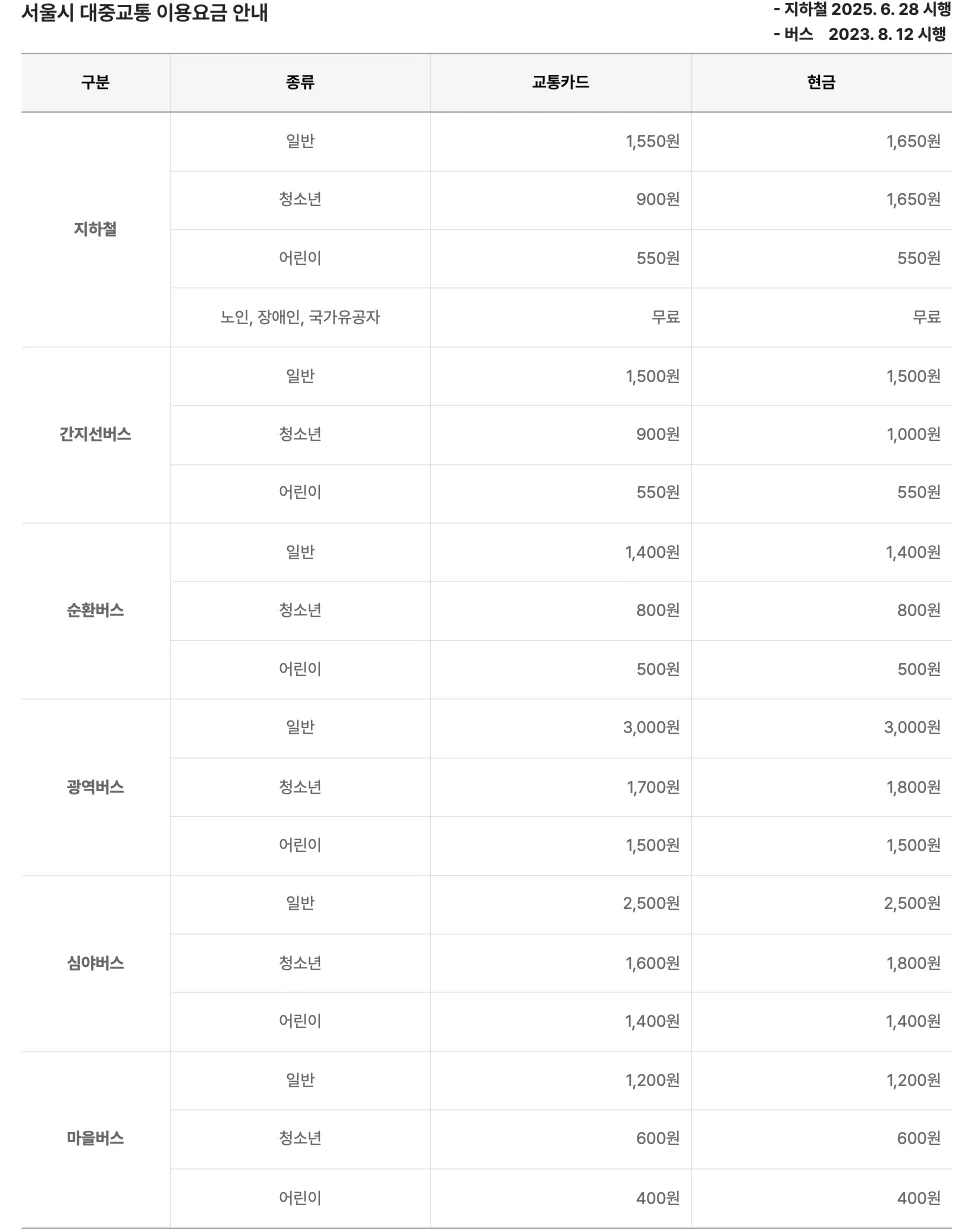
Seoul fares, as of the last increases: the subway on 28 June 2025, the buses on 12 August 2023. Those two dates are printed in the top-right corner of the operator’s own table, which is the photograph at the top of this page and again, in full, further down. Every number in the table below is read off it.
| T-money card | Cash or ticket | |
|---|---|---|
| Subway (adult) | 1,550 won | 1,650 won |
| Trunk and branch bus (blue, green) | 1,500 won | 1,500 won |
| Circular bus | 1,400 won | 1,400 won |
| Village bus (small green) | 1,200 won | 1,200 won |
| Late-night bus | 2,500 won | 2,500 won |
| Wide-area bus (red) | 3,000 won | 3,000 won |
Read the bus rows again. Cash and card cost exactly the same on a Seoul bus. Plenty of English pages state the opposite as a reason to buy the card. On the subway you save 100 won a ride, and the single-journey card also holds a 500 won deposit you have to remember to reclaim from a machine at your destination.
So on raw fares, a card saves a tourist perhaps a few hundred won a day. That is not the argument for it.
The argument for it
Tag on at the start, tag off at the end, and the system stops treating your trip as a series of rides and starts treating it as one journey.
| Rule | Detail |
|---|---|
| Transfers allowed | Up to 4, so 5 boardings in one chain |
| Time limit | Board the next one within 30 minutes of tagging off |
| At night | 60 minutes, if you board between 21:00 and 07:00 |
| What you pay | The highest base fare of the modes used, not the sum |
| Distance | Free to 10km, then 100 won per 5km (30km on wide-area buses) |
| Does not count | Same route or same vehicle |
An example with real numbers. Bus to the station, subway across town, village bus up the hill: three vehicles, one fare. The chain is priced at the dearest base fare in it, so 1,550 won for the subway rather than 1,500 plus 1,550 plus 1,200. You tap the bus for 1,500, and the subway collects the 50 won difference.
That is a 2,700 won saving on a single trip across town, and you make that trip twice a day. It dwarfs the 100 won.
The habit that quietly costs you
You must tag the reader on the way out as well as in. On the subway the gate forces you. On a bus nothing forces you, and a lot of visitors walk off the back door without touching the pole reader.
Here is what the city says happens. The chain breaks at the vehicle you failed to tag off. When you next board something, that untagged ride gets re-priced as a standalone journey and the fare it did not collect is taken then. You do not get a fine. You get the discount removed, retroactively, at a moment when you have no idea why the number is wrong.
There is a second timer worth knowing. Stay aboard past the maximum ride time and the base fare is charged again when you get off: five hours on the subway, five on a city bus, one hour on a village bus.
The discount for early flights
If your first tap of the day is before 06:30, you get 20% off the base fare. It applies to card payments only, which is one more reason to have the card before the morning you need it.
The city’s own worked example: a village bus before 06:30 costs 960 won instead of 1,200. Transfer to a city bus afterwards and the difference is charged at the normal rate, not the discounted one, so 300 won more. Total 1,260 for a chain that would otherwise be 1,500.
Anyone leaving for a morning flight is up in that window anyway.
The pass everyone recommends is being switched off
Seoul’s Climate Card is a flat-rate unlimited pass for the city’s buses and subway. The 30-day version at 62,000 won is in a great many English guides.
It is being discontinued. The city published the schedule on 3 July 2026 and then revised it on 30 July, moving every date back by a month. These are the current ones:
| Date | What happens |
|---|---|
| 31 August 2026 | Last day to charge a prepaid 30-day pass (passed) |
| 1 September 2026 | Charging stopped (passed) |
| 29 September 2026 | Last day a prepaid pass works |
| 30 September 2026 | Last day a postpaid pass works |
| 1 October 2026 | Service ends |
Updated 2 August 2026. This page originally carried the July schedule, which ran a month earlier and ended the service on 1 September. The city rewrote the notice on 30 July at the same URL, without changing the address, to avoid a gap between the old pass ending and the replacement starting. A card charged on 31 August still runs to its own expiry, which is what pushes the last prepaid day out to 29 September.
What the table does not show is that the pass pays something back on the way out. If you charged a 30-day Climate Card in the spring and let it run to expiry, Seoul owes you a refund on it, and that claim closes on the same day as the last charge. Foreign residents claim it on paper rather than online.
The reason is not that it failed. The national government launched its own unlimited product in 2026 at comparable pricing, the two schemes overlapped, and Seoul is folding its version into the national one to stop running two of the same thing. That replacement is a residency check rather than a card, which matters a great deal if you are visiting.
The short-term passes survive. The city states this explicitly in its end-of-service FAQ, because they cannot be merged into the national scheme:
| Pass | Price | Journeys per day to beat pay-as-you-go |
|---|---|---|
| 1 day | 5,000 won | 4 |
| 2 day | 8,000 won | 3 |
| 3 day | 10,000 won | 3 |
| 5 day | 15,000 won | 2 |
| 7 day | 20,000 won | 2 |
That last column is the one to look at, and it is why the transfer rules had to come first. A journey is a whole chain, not a vehicle. Sightseeing days are usually two chains: out in the morning, back at night. Under that pattern the one and two-day passes lose, and the five and seven-day ones win comfortably.
Practical notes. The short-term pass starts the day you charge it, and cannot be bought in advance. It runs from the first train at 04:00 on day one to the last train on the final day. It does not include the bike share. Physical cards are sold at ticket machines inside subway stations on lines 1 to 8 and at convenience stores near stations, and need registering online if you ever want a refund. The newer machines will now sell you one of these passes on a foreign card, which is a change from the cash-only errand this used to be, though putting money on the plain T-money card is still not something they do.
The airport asymmetry
The Climate Card is drawn on a map, and the map is Seoul. Outside it: the Sinbundang line, GTX, wide-area and airport buses, buses licensed by other cities, and subway stations past the boundary. On the airport railroad the pass covers Gimpo Airport to Seoul Station and no further.
Board inside the zone, get off outside it, and staff at the exit gate collect the full fare from you by hand.
There is one exception, and it is genuinely useful. You may board inside the zone and get off at Incheon Airport Terminal 1 or 2. You may not board at those stations.
So the pass takes you to your flight and cannot bring you in from it. On arrival day you are paying for the airport train like everyone else, which is the trip in article one. Buy the pass afterwards, in the city, on the morning you start using it.
What I would do
Two or three days in Seoul: a plain T-money card, topped up with roughly 20,000 to 30,000 won. Tag off every time. You will spend less than a pass and the card still works in Busan, in taxis and at convenience store counters, none of which a Seoul pass touches.
Five days or more, staying inside the city: the 5 or 7-day pass, bought on your first full day. Keep a T-money card as well for the trips that leave the zone.
Either way, do not buy the 30-day pass. In September it is a countdown, and in October it is a piece of plastic.
If you live here rather than visiting, that advice inverts and the replacement sorts you by where you are registered, which is the decision the shutdown actually forces.
What is not checked here yet
Fares, transfer rules, the early-bird discount, the Climate Card prices and the shutdown dates all come from the city’s and the operator’s own Korean pages. I opened the fare page again on 20 September 2026, checked all six bus and subway rows line by line against the table below, and photographed it as it stood that day, which is where the two screenshots on this page come from. Nothing had moved.
I have not verified what a blank T-money card costs at a convenience store counter, or the fee and ceiling for cashing out a leftover balance there. The official pages I can find cover refunds for faulty cards, not the ordinary counter refund every visitor wants on their last morning. That one still gets its own page with its own date.
The other gap on this page has been closed. It used to say I was unsure whether the national scheme replacing the 30-day pass was open to short-stay visitors. It is not, and the reason turned out to be worth its own article: the sign-up reads a registration number rather than applying any nationality rule, so registered residents are in and visitors are not.
If you have been through one of them recently, tell me. And if you need a Korean number before you can register for anything, that is the other article.
Open this tool on its own page →
Questions people actually ask
- How much is T money card in Korea, and what does the 3,000 won buy?
- The card itself is 3,000 won at a convenience store or a station machine, and that is a purchase rather than a deposit: it is not refunded when you leave. What you load on top is yours, minus a 500 won fee when you cash it out. The card then saves you 100 won per subway ride against a single-journey ticket and nothing at all on a Seoul city bus, where cash and card are both 1,500 won.
- Does T money card expire, and does the balance expire with it?
- The card does not expire, and the balance on it does not either. What has a deadline is the Climate Card pass some people load onto one: Seoul stopped accepting top-ups for the 30-day prepaid pass on 31 August 2026, the last day such a pass works is 29 September, and the scheme closes on 1 October. A plain T-money balance is unaffected by any of that.
- T money card cost against a day pass: is it worth it for a short trip?
- It pays for itself through transfers rather than through the per-ride discount. Tag on and tag off and a bus into a subway into another bus within 30 minutes is charged as one journey instead of three. The 100 won saving per subway ride alone would take thirty rides to cover the 3,000 won card, so the transfer rule is the reason to buy one, not the fare.
- Which T money pass Seoul still sells, and which card to buy for the subway
- For a few days, a plain T-money card or one of the short Climate Card passes, which run 5,000 to 20,000 won for one to seven days and cover Seoul only. Do not buy the 30-day Climate Card in 2026: it can no longer be topped up after 31 August and stops working on 29 September. The short passes will carry you out to Incheon Airport but not back in.
Where these numbers came from
Read on . 8of8are the operator's own Korean pages.
- Seoul Metropolitan Government, public transport fares and transfer rules KO
- Seoul Metropolitan Government, integrated transfer discount scheme KO
- T-money, Seoul public transport fare table KO
- T-money, where the cards are sold KO
- Seoul Metropolitan Government, Climate Card pass types and prices KO
- Seoul Metropolitan Government, Climate Card end-of-service FAQ KO
- Seoul Metropolitan Government, notice ending the 30-day Climate Card KO
- AREX fare page, showing the 500 won single-journey card deposit KO